Module 3.0 - Real Neural Networks
Map Gradient

Example: Tensor Inversion
- $G^{i}(x) = 1 / x_i$
$G'^{i}_{x_i}(x) = -(x_i)^{-2}$
$f'_{x_i}(G(x)) = -(x_i)^{-2} * d_i$
Example: Inv
In [2]:
class Inv(minitorch.Function):
    @staticmethod
    def forward(ctx, t1: Tensor) -> Tensor:
        ctx.save_for_backward(t1)
        return t1.f.inv_map(t1)

    @staticmethod
    def backward(ctx, d: Tensor) -> Tensor:
        (t1,) = ctx.saved_values
        return d.f.inv_back_zip(t1, d)
Example: Multiplicaiton
- $G^{i}(x, y) = x_i * y_i$
$G'^{i}_{x_i}(x, y) = y_i$
$f'_{x_i}(G(x, y)) = y_i * d_i$
Example: Mult
In [3]:
class Mul(minitorch.Function):
    @staticmethod
    def forward(ctx, t1: Tensor, t2:Tensor) -> Tensor:
        ctx.save_for_backwards((t1, t2))
        return t1.f.mul_map(t1, t2)

    @staticmethod
    def backward(ctx, d: Tensor) -> Tensor:
        (t1, t2) = ctx.saved_values
        return d.f.mul_map(t2, d), d.f.mul_map(t1, d)
Example: Sum
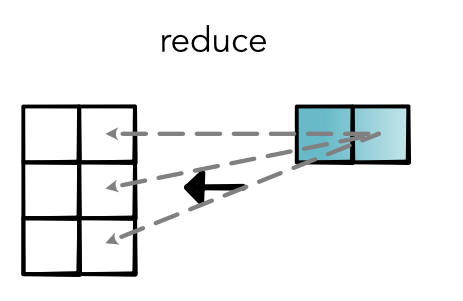
- $G(x) = \sum_i x_i$
$G'_{x_i}(x) = 1$
$f'_{x_i}(G(x)) = d$
Reduce Gradient
Quiz
Outline
- Training
- Simple NLP
Training
Model: Math
$$ \begin{eqnarray*} \text{lin}(x; w, b) &=& x_1 \times w_1 + x_2 \times w_2 + b \\ h_ 1 &=& \text{ReLU}(\text{lin}(x; w^0, b^0)) \\ h_ 2 &=& \text{ReLU}(\text{lin}(x; w^1, b^1))\\ m(x) &=& \text{lin}(h; w, b) \end{eqnarray*} $$
Simple Dataset
In [4]:
split_graph(s1, s2)
Out[4]:
Parameter Fitting
- Compute the loss function, $\mathcal{L}(\theta)$
- See how small changes would change the loss
- Update to parameters to locally reduce the loss
Batching
How to Compute Loss
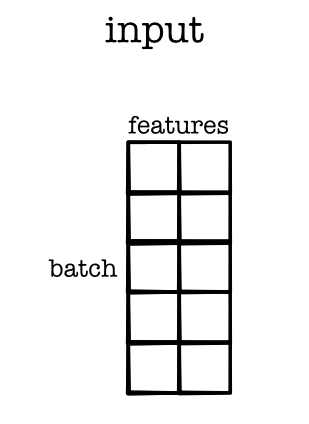
# X - (BATCH, FEATURES)
out = model.forward(X)

# out - (BATCH)
l = loss(out)

# l - (1)
Model: Code
class Network(minitorch.Module):
  def __init__(self):
    ...
    self.layer1 = Linear(FEATURES, HIDDEN)
    self.layer2 = Linear(HIDDEN, HIDDEN)
    self.layer3 = Linear(HIDDEN, 1)
Layer 1: Weight
Layer 1: Bias
Linear Model
- Use broadcasting to implement the linear function
- Sizes
- X - (BATCH, FEATURES)
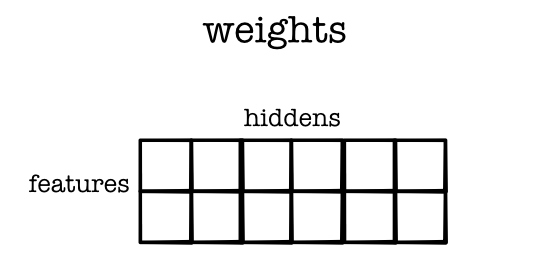
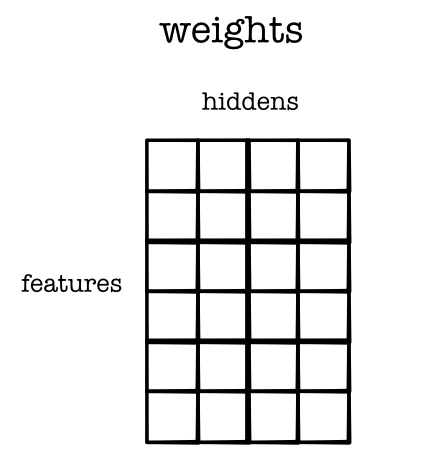
- weight - (FEATURES, HIDDEN)
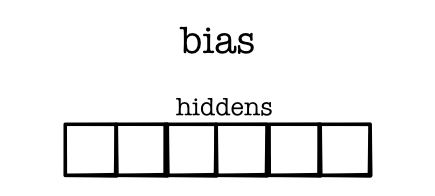
- bias - (HIDDEN)
How Much Does it Cost?
- Counting the operations
- Counting the memory
Layer 2: Weights
Layer 1: Weight Grad
Update Parameters
Step 3
for p in model.parameters():
  if p.value.grad is not None:
    p.update(p.value - RATE * (p.value.grad / float(data.N)))
Broadcasting
- Batches
- Loss Computation
- Linear computation
- Autodifferentiation
- Gradient updates
Observations
- Exactly the same function as Module-1
- No loops within tensors
Simple NLP
Sentiment Classification
- Canonical sentence classification problem
- Given sentence predict sentiment class
- Key aspects: word polarity


What is a word?
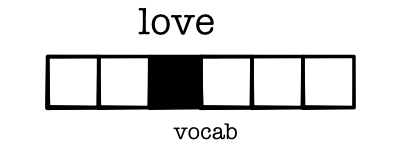
- Treat words as index in vocabulary
- Represent as a one-hot vector
Layer 1
- First layers is called an
embedding
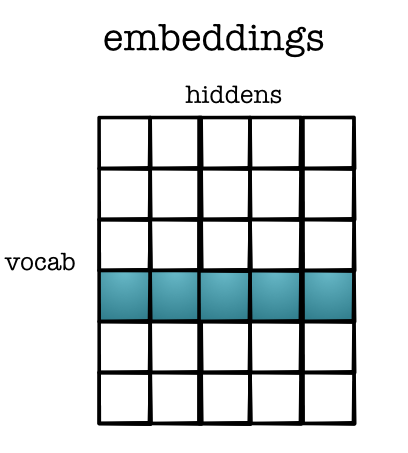
Hidden vector for word
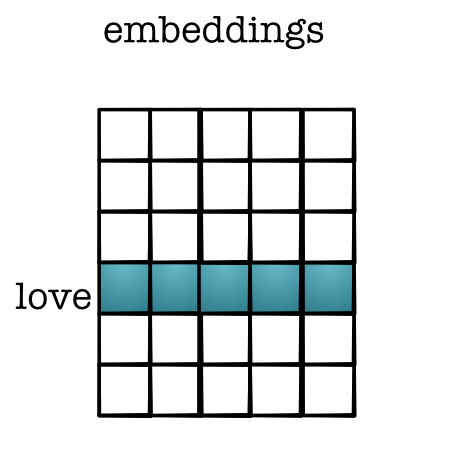
Get word vector
word_one_hot = tensor([0 if i != word else 1
                       for i in range(VOCAB)])
embedding = (layer1 * word_one_hot).sum(1)
How does this share information?
- Similar words have similar embedding dim
- Dot-product - easy way to tell similarity
(word_emb1 * word_emb2).sum()- Differentiable!
Where do these come from?
- Trained from a different model
- Extracted and posted to use
- (Many more details in NLP class)
Examples
Query 1
^(lisbon|portugal|america|washington|rome|athens|london|england|greece|italy)$Query 2
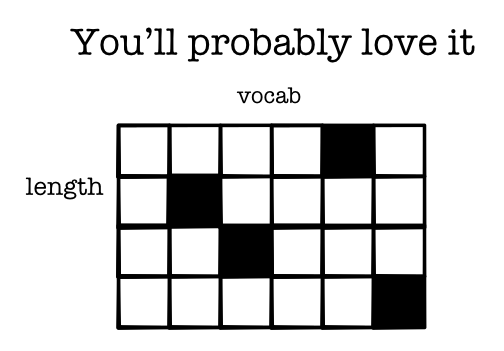
^(doctor|patient|lawyer|client|clerk|customer|author|reader)$Sentence Length
- Examples may be of different length
- Need to all be converted to vectors and utilized
Value Transformation
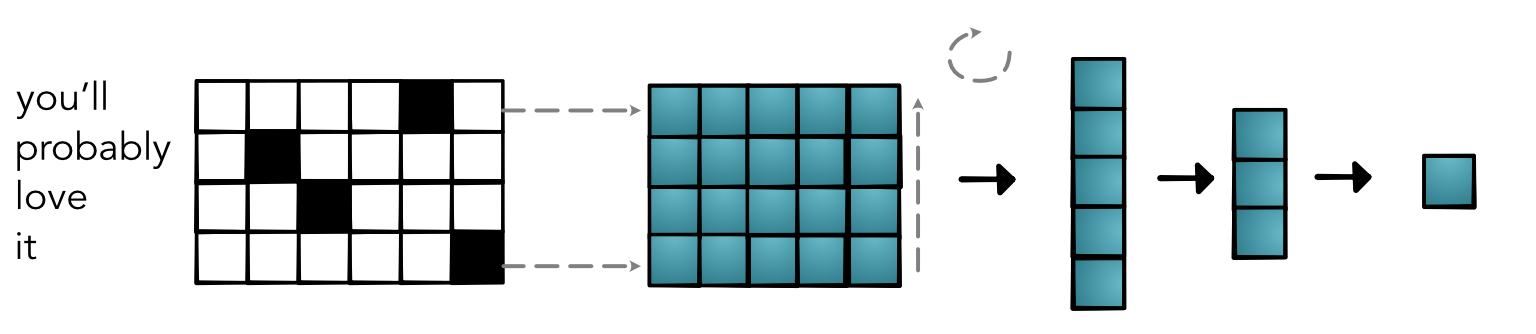
- batch x length x vocab
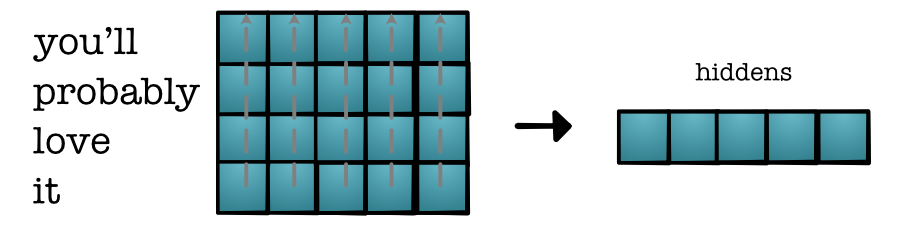
- batch x length x feature
- batch x feature
- batch x hidden
- batch
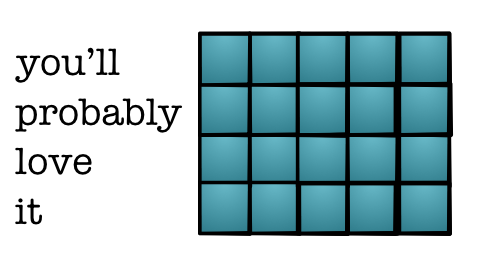
Pooling
Benefits
- Extremely simple
- Embeddings encode key information
- Have all the tools we need
Full Model
Issues
- Ignores relative order
- Ignores absolute order
- Embeddings for all words, even rare ones