Module 3.3 - CUDA: Memory


Thread Names
Printing code
@cuda.jit()
def printer(a):
    print(cuda.threadIdx.x, cuda.threadIdx.y)
    a[:] = 10 + 50
a = np.zeros(10)
printer[1, (10, 10)](a)
`
Thread Names
def printer(a):
    print(cuda.blockIdx.x,
          cuda.threadIdx.x, cuda.threadIdx.y)
    a[:] = 10 + 50
a = np.zeros(10)
printer[10, (10, 10)](a)
What's my name?
BLOCKS_X = 32
BLOCKS_Y = 32
THREADS_X = 10
THREADS_Y = 10
def fn(a):
    x = cuda.blockIdx.x * THREADS_X + cuda.threadIdx.x
    y = cuda.blockIdx.y * THREADS_Y + cuda.threadIdx.y
fn = cuda.jit()(fn)
fn[(BLOCKS_X, BLOCKS_Y), (THREADS_X, THREADS_Y)](a)
Stack
- Threads: Run the code
- Block: Groups "close" threads
- Grid: All the thread blocks
- Total Threads:
threads_per_blockxtotal_blocks
Simple Map
BLOCKS_X = 32
THREADS_X = 32
@cuda.jit()
def fn(out, a):
    x = cuda.blockIdx.x * THREADS_X + cuda.threadIdx.x
    if x < a.size:
        out[x] = a[x] + 10

fn[BLOCKS_X, THREADS_X](out, a)
Quiz 
Outline
- Memory
- Example: Slides
- Example: Reduction
Memory
Names
- Why do the names matter?
- Determine communication
- Locality is key for speed.
Memory
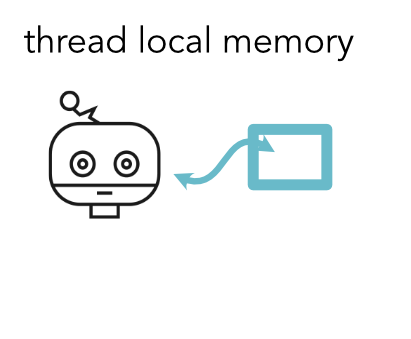
- CUDA memory hierarchy
- Local > Shared > Global
- Goal: minimize global reads and writes
Example
@cuda.jit()
def local_fn(out, a):
    i = cuda.threadIdx.x
    local = cuda.local.array(10, numba.int32)
    local[0] = 10
    local[5] = local[0] + 10
    out[i] = local[5]

local_fn[BLOCKS, THREADS](out, a)
out
Constraints
- Memory must be typed
- Memory must be constant size
- Memory must be relatively small
BAD Example
def local_fn(out, a):
    local = cuda.local.array(a.size, numba.int32)
    local[0] = 10
    local[5] = 20

local_fn = cuda.jit()(local_fn)
local_fn[BLOCKS, THREADS](out, a)
GOOD Example
CONSTANT = 10
def block_fn(out, a):
    shared = cuda.local.array(CONSTANT, numba.int32)
    shared[0] = 10
    shared[5] = 20
block_fn = cuda.jit()(block_fn)
block_fn[BLOCKS, THREADS](out, a)
`
Communication
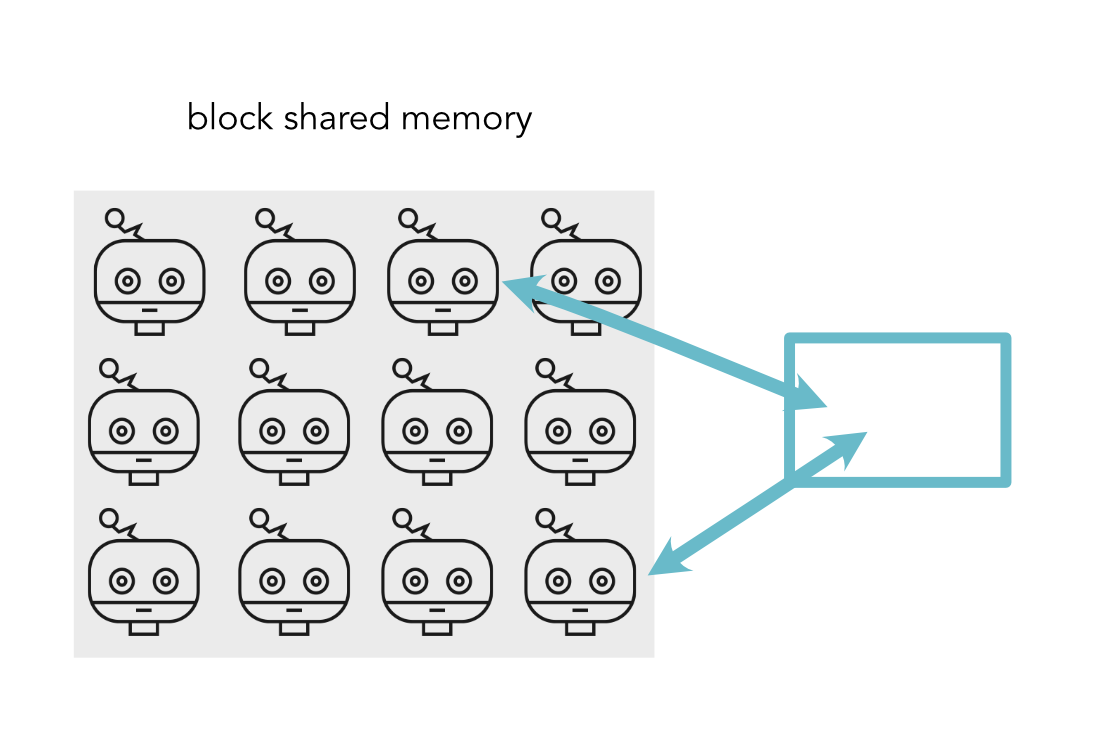
- Threads in a block have shared memory
- Need to
syncto ensure it is written before you read
Shared Example
@cuda.jit()
THREADS = 10
def block_fn(out, a):
    shared = cuda.shared.array(THREADS, numba.int32)
    i = cuda.threadIdx.x
    shared[i] = a[i]
    cuda.syncthreads()
    out[i+1 % THREADS] = shared[i]

block_fn[1, THREADS](out, a)
Constraints
- Memory must be typed
- Memory must be constant size
- Memory must be relatively small
Algorithms
Thinking about Speed
- Algorithms: Reduce computation complexity
- Typical: Remove loops, code operations
Sliding Average
Compute sliding average over a list
sub_size = 2
a = [4, 2, 5, 6, 2, 4]
out = [3, 3.5, 5.5, 4, 3]
Local Sum
Compute sliding average over a list
def slide_py(out, a):
    for i in range(out.size):
        out[i] = 0
        for j in range(sub_size):
            out[i] += a[i + j]
        out[i] = out[i] / sub_size
Planning for CUDA
- Count up the memory accesses
- How many global / shared / local reads?
- Can we make move things to be more local?
Basic CUDA
@cuda.jit
def slide_cuda(out, a):
   i = cuda.threadIdx.x
   if i + sub_size < a.size:
       out[i] = 0
       for j in range(sub_size):
            out[i] += a[i + j]
       out[i] = out[i] / sub_size
Planning for CUDA
sub_sizeglobal reads per threadsub_sizeglobal writes per thread- Each is being read too many times.
Strategy
- Use blocks to move from global to shared
- Use thread to move from shared to local
Better CUDA
One global write per thread
@cuda.jit()
def slide_cuda(out, a):
    i = cuda.threadIdx.x
    if i + sub_size < a.size:
        temp = 0
        for j in range(sub_size):
            temp += a[i + j]
        out[i] = temp / sub_size
Pattern
Copy from global to shared
local_idx = cuda.threadIdx.x
shared[local_idx] = a[i]
cuda.syncthreads()
Better CUDA
@cuda.jit
def slide_cuda(out, a):
    shared = cuda.shared.array(THREADS + sub_size)
    i = cuda.threadIdx.x
    if i + sub_size < a.size:
        shared[i] = a[i]
        if i < sub_size and i + THREADS < a.size:
            shared[i  + THREADS] = a[i + THREADS]
        cuda.syncthreads()
        temp = 0
        for j in range(sub_size):
            temp += shared[i + j]
        out[i] = temp / sub_size
Counts
- Significantly reduced global reads and writes
- Needed block shared memory to do this
Example 2: Reduction
Compute sum reduction over a list
a = [4, 2, 5, 6, 1, 2, 4, 1]
out = [26]
Algorithm
- Parallel Prefix Sum Computation
- Form a binary tree and sum elements
Associative Trick
Formula $$a = 4 + 2 + 5 + 6 + 1 + 2 + 4 + 1$$ Same as $$a = (((4 + 2) + (5 + 6)) + ((1 + 2) + (4 + 1)))$$
Associative Trick
Round 1 $$a = (((4 + 2) + (5 + 6)) + ((1 + 2) + (4 + 1)))$$ Round 2 $$a = ((6 + 11) + (3 + 5))$$ Round 3 $$a = (17 + 8)$$ Round 4 $$a = 25$$
Thread Assignments
Round 1 (4 threads needed, 8 loads) $$a = (((4 + 2) + (5 + 6)) + ((1 + 2) + (4 + 1)))$$
Round 2 (2 threads needed, 4 loads) $$a = ((6 + 11) + (3 + 5))$$ Round 3 (1 thread needed, 2 loads) $$a = (17 + 8)$$ Round 4 $$a = 25$$
Open Questions
- When do we read / write from global memory?
- Where do we store the intermediate terms?
- Which threads work and which do nothing?
- How does this work with tensors?
Table
   | Thread 0 |  Thread 1 | Thread 2 | Thread 3 |
   |----------|-----------|----------|----------|
   | 4 + 2    |  5 + 6    | 1 + 2    |  4 + 1   |
   | 6 + 11   | (zzz)     |  3 + 5   |  (zzz)   |
   | 17 + 18  | (zzz)     | (zzz)    |(zzz)     |
Harder Questions
- What if the sequence is too short?
- What if the sequence is too long?
Too Short - Padding
- Recall that we always have a
start, e.g. 0 - Can pad our sequence with
start - In practice can be done by initializing shared memory.
Too Long - Multiple Runs
Sequence may have more elements than our block.
Do not want to share values between of blocks.
However, can run the code multiple times.
Example - Long Sequence
Formula $$a = 4 + 2 + 5 + 6 + 1 + 2 + 4 + 1 + 10$$ Block size 8 $$a = (((4 + 2) + (5 + 6)) + ((1 + 2) + (4 + 1))) + 10$$